

Are you a farmer or a florist? Do you run a restaurant or a brewery?
If you fall into any of these groups, then you know the value of reliable cold storage. Without it, your business could very well fail.


The most common type of cold storage found on farms and in florist shops, restaurants, and breweries is a walk-in cooler. It may seem like a pretty standard piece of equipment, but not all walk-in coolers are created equal.
In this guide, we’ll look at the different types of commercial walk-in coolers on the market and give you the information you need to select the right one for your business. You’ll learn the main differences between the options, what factors you need to take into account, and how to make sure you’re getting the most cost-effective solution.
We’ll start with the most important aspect of any walk-in cooler: the refrigeration system.
Download this guide in pdf format by clicking the image below.


Refrigeration Systems for Commercial Walk-In Coolers
The refrigeration system is the core component of any walk-in cooler. As you’ll see later in this guide, many parts of a cooler system are standard — the box is two sheets of metal with insulation in the middle, the door has industrial-grade hinges and a self-closing mechanism, and so on. The main difference between the available options lies in the refrigeration system.
There are three main types of refrigeration systems available for commercial walk-in coolers.
Self-Contained Refrigeration System
A self-contained system is a closed system that’s essentially plug-and-play. All of the parts — the compressor, the fan, the motor, and so on — are contained in one main structure that’s sealed at the factory. This system usually sits on the roof of the cooler and blows cold air through a hole in the ceiling.
There are two main things you need to know about this system, because in some circumstances they can be disadvantages:
- If the unit is located inside, it will blow hot air into the room. This might not be ideal in a room with low ceilings or in a space like a restaurant kitchen.
- Because the motor and fans are located inside, the unit can be noisy.
Remote Refrigeration System
A remote system is different in that it’s not a one-piece system. It has two parts, one located on the cooler and one located remotely.
- The indoor unit, called the evaporator, houses the cold part of the coil with the fan.
- The outdoor unit, which sits external to the cooler, contains the motor and other parts. This unit may be outside the unit, but still inside the building — for example, on the roof of the cooler, but still inside a restaurant. Or it may be outside the building altogether.
CoolBot Refrigeration System
The CoolBot refrigeration system is the simplest of the three. It’s similar to a self-contained system in that it’s plug-and-play and doesn’t require a separate unit on the outside. But, rather than a large commercial cooling unit, the CoolBot system offers the same cooling power using only a CoolBot Temperature Controller and a standard window air conditioner.
Comparing Refrigeration Systems
All three of these solutions provide effective cooling, as long as you have a well-insulated room, a level floor, and your cooler meets the other requirements in this guide. However, they vary significantly in terms of how easy they are to set up, their maintenance requirements, energy consumption, and more.
The table below compares the three solutions on these key factors.
| Self-contained walk-in cooler | Remote walk-in cooler | CoolBot Walk-in Cooler | |
| Installation | – Requires electrician to ensure compliance with local codes. Does not require professional installation, but you may need special equipment to lift the unit on top of the cooler. | – Requires electrician to ensure compliance with local codes. Requires professional installation, including piping, a vacuum, refrigerant charge, etc. | – Requires electrician to ensure compliance with local codes. |
| Power | – Usually 208V or 220V. | – Usually 208V or 220V. | – A window air conditioner can work on 115V for an 8’x8’ cooler. |
| Energy Usage | – Multiple large fans with high energy requirements. | – Must supply power to the indoor unit, the outdoor unit, and multiple large fans with high energy requirements. | – Only power to a window air conditioner and the CoolBot. |
| Drainage | – Has its own drainage system, similar to a window air conditioner. | – Requires special drainage system to meet local codes. | – No extra drain required. The air conditioner collects condensation in a drip pan. |
| Maintenance | – Professional maintenance required. | – Professional maintenance required. | – Simple maintenance that anyone can perform. |
The refrigeration system also determines the differences in cost between the coolers. Because of its simple, straightforward refrigeration system (just a CoolBot and an air conditioner), the CoolBot Walk-in Cooler is anywhere from $1,500 to $2,500 less expensive than a traditional commercial walk-in cooler for just the unit. If you take into account installation costs, the CoolBot Walk-in Cooler will save you $2,500 to $4,000.
And that’s just in upfront costs. The CoolBot Walk-in Cooler will continue to save you money over the life of your cooler because it’s the most energy-efficient solution and doesn’t require professional maintenance.
Now that you’re familiar with the advantages and drawbacks of the different refrigeration systems, let’s turn to the construction of the cooler itself.
Cooler Construction
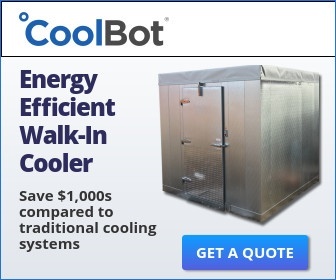

The Cooler Box
The industry standard is something like an ice cream sandwich. But instead of cookies you have two sheets of industrial strength galvanized steel, and instead of ice cream you have insulation.
The steel panels are connected using a Camlock system of hooks and pins. Usually there’s a lock every 2 feet on all sides of each panel, connecting it to the ceiling, the floor, and the adjacent panel. Gaskets around the perimeter ensure a perfect seal with no air condensation.
For insulation, the standard is 4 inches, using either extruded polystyrene or polyurethane.
Extruded polystyrene, which is pink or blue, is the best choice because it’s very dense. It repels water well and also does a great job of holding its R-value (the higher the R-value, the stronger the insulating power). Polyurethane, which is yellow, is less dense, but it still provides great results.
The minimum insulation value required by law is R-25. The CoolBot Walk-in Cooler comes with R-28 standard along with a 10-year warranty.
And that’s it for the cooler box. Sometimes you’ll have options for upgrades. For example, the metal surfaces may be coated with paint for aesthetics, to avoid corrosion, or for easier cleaning. But, otherwise, no matter which solution you’re looking at, the above information will apply.
The Door
The second major structural component of the cooler is the door.
A high-quality door is important, especially in an environment like a restaurant, where it may be opened and closed several times a day. If you don’t have a good door, the hinges will become loose, resulting in air gaps and wasted energy. A high-quality door will survive years of frequent opening and closing, ensuring the cold air you’re paying to generate stays inside the cooler.
Here’s what to look for in your cooler door:
- Industrial-grade hinges
- Gaskets to provide a tight seal
- A self-closing mechanism
- A temperature readout display on the outside
The Floor
Finally, one of the most common questions we hear, from customers considering a turnkey solution as well as from those building their own coolers, is whether or not they need an insulated floor.
As a general rule, an insulated floor is always better. And a floor is necessary if you want your cooler to be able to reach temperatures below 37°F. Regardless of the refrigeration system in your cooler, an insulated floor will result in energy savings of about 15%. That savings quickly makes up for the larger upfront investment.
Here are a few more tips about the cooler floor:
- Your cooler must be on a flat surface so you can achieve square seams and a tight door. If the floor isn’t level, your panels won’t align correctly, which will cause leaks, making your cooler less efficient.
- Concrete on its own is not a good insulator. If you want to use concrete, you’ll need to do an insulation treatment on the slab before you pour the concrete.
- If your cooler will live outside, you’ll want an insulated floor to help keep water and small creatures from getting in.
- Any time you have empty space underneath your cooler, even if it’s only a couple of inches, you should insulate the floor to protect against heat from below. This applies equally to basements and crawl spaces as it does to elevated coolers like those built in shipping containers or on decks or trailers.
Questions to Help You Choose the Best Cooler for Your Needs
In this last section, we’ll guide you through three questions to ask yourself to ensure you’re getting the cooler that best fits your needs.
How Big Does Your Cooler Need to Be?
When it comes to a walk-in cooler, one of the most expensive mistakes you can make is buying a bigger one than you actually need.
It’s tempting to think bigger is always better. But keep in mind that the bigger your cooler is, the more expensive it will be upfront and the more power it will require to run, which means it will continue to cost you more throughout its lifetime.
Plus, you’d be amazed at how much product you can fit into a small cooler if you organize it well. Even an 8’x8’ cooler can hold 1000s of pounds of product!
Here are a few recommendations for fitting more into your cooler space:
- Coolers with self-contained or CoolBot refrigeration systems can hold more product than coolers with remote refrigeration systems. This is because with a remote system the fan takes up some space inside the cooler. In a CoolBot Walk-in Cooler, the CoolBot Temperature Controller and the air conditioner are flush or nearly flush against the wall, so you don’t lose any space to hardware.
- The best way to organize your cooler is using shelves around the outside with space in the middle for you to move around.
- For the most efficient cooling, never put anything in front of the refrigeration unit or fans because you will block the airflow.
How Much Cooling Do You Need?
Depending on what you’re storing, you may need more or less cooling. For example, florists usually only require cooling down to 42°F, while farmers storing fresh produce may need to cool down to 36°F or 37°F. Whether or not greater cooling power will cost you more money depends on the type of cooler you buy.
For a cooler built with a traditional self-contained or remote refrigeration unit, greater cooling power will usually be more expensive. When you call the supplier, they will ask you several questions — for example, about the ambient temperature, the incoming temperature, the pounds of product, etc. — and put your answers into a formula that will determine your recommended cooling power. Then, if you purchase a cooler designed for cooling down to 42°F, you might not be able to reliably get it to go any lower.
The refrigeration system in the CoolBot Walk-in Cooler has been sized to handle most of the typical applications in the market for the relevant cooler size.
Where Will You Put Your Cooler?
If possible, we recommend putting your cooler inside. That way, it’s protected from the environment, so you don’t have to worry about water getting in or direct sun causing temperatures to rise. Even putting your cooler in a barn or underneath an awning can provide the necessary protection.
If you do decide to put your cooler outside, here are a few things to keep in mind:
- You definitely want an insulated floor, for the reasons outlined earlier.
- You’ll need to protect the top of the cooler from rain and snow. Water is sneaky, and it can get in even when the cooler is sealed properly. We recommend installing an industrial-grade membrane on the roof of the cooler.
- If your refrigeration unit is outside, the compressor will need to be protected and winterized.
No matter what type of cooler solution you select, you’ll need an outdoor package. So, be sure to talk with your supplier about the best way to protect your cooler from the elements.
________________________
A commercial walk-in cooler is a great investment for the future of your business! We hope this guide will help you better understand the different aspects of a walk-in cooler so you can select the one that is most energy-efficient and cost-effective.
If you have any questions about the information in this guide or need help figuring out the correct sizing, cooling power, and so on for your products, give us a call at 888-871-5723 or send us an email (cooler@storeitcold.com). We’d be happy to help you find a cooler that fits your needs and your budget.
